1. Introduction: From Computation to Formulation
Recent work suggests that large language models (LLMs) could substantially reduce the time required for a meaningful share of work tasks, although this evidence concerns technical exposure rather than realized adoption or productivity effects (Eloundou et al., 2024). This paper therefore treats the decline in downstream execution cost as a motivating premise, not as a result derived from that study. Once a task is specified well enough, the premise is that downstream execution becomes cheaper and upstream formulation becomes more consequential. This premise is consistent with long-standing visions of human-computer symbiosis, in which humans set goals, formulate hypotheses, determine criteria, and evaluate results, while computers perform routinizable work (Licklider, 1960).
Research on AI-advised decision making shows that higher model accuracy is not sufficient for higher team performance, because outcomes also depend on how people understand and use the system (Bansal et al., 2019). Empirical reviews further show that human-AI decision making must be studied through the decision task, the form of AI assistance, and the evaluation used, rather than inferred from model capability alone (Lai et al., 2023). In data science, practitioners likewise describe a future in which automation and human expertise remain jointly necessary (Wang et al., 2019). Design guidance emphasizes understandable interaction, user control, explanation, and attention to social context (Amershi et al., 2019; Shneiderman, 2020). Human-AI teaming research documents that work increasingly requires people to collaborate with AI as well as with each other, and argues for a shift from technology-driven questions to a human-centered design agenda (Berretta et al., 2023). At the institutional level, existing audit practices do not yet resolve the governance challenges raised by LLMs (Mökander et al., 2024). Machine-behavior research therefore argues that AI systems should be studied together with the social environments, incentives, and constraints in which they operate (Rahwan et al., 2019).
Against this background, this paper takes an explicitly ontological stance on human-AI collaboration. Here, ontological is used in an operational sense. Rather than focusing only on workflow optimization or interface design, the paper sets out the kinds of entities, roles, and structural relations that make up a joint human-AI system of action. It then asks what positions humans and AI hold within it. In the same operational spirit, teleology refers throughout to the setting of goals, evaluative criteria, and normative constraints that fix what counts as success in a given episode. It does not refer to anything in a broader metaphysical sense. This operational reading is consistent with Floridi’s account of current generative AI as agency without intelligence (Floridi, 2023). The stronger claim adopted here, that the system does not fix the governing goals, criteria, or constraints of the episode, is this paper’s modeling proposal rather than a result established by Floridi. In this operational sense, teleology is supplied through human specification, and responsibility is anchored in the human declaration of goals and constraints.
To make this distinction operational rather than just a matter of words, the paper uses a deliberately mathematical style of analysis. The mathematical expressions are not meant mainly as tools for numerical prediction or optimization. They are conceptual devices. They fix boundaries, hold distinctions steady, and make clear how roles, constraints, and responsibilities are assigned. They separate intent, execution, and evaluation, and treat each as an analytically distinct part of the interaction. By making these separations explicit, the formalism shows where control can be exercised, where ambiguity can enter, and where failure can arise.
This shift in attention upstream raises a question the diagnosis itself leaves open: how should the upstream burden be modeled? We separate two things that are easy to conflate. One is what a specification is, how complete and well-formed it is, which we will call its amplitude. The other is what producing such a specification costs the user in effort. These are distinct axes. A more complete specification is not the same as a more costly one, and the cost of producing the same specification can differ with the instruction-environment quality.
Throughout the paper, we hold the decoding system fixed and ask what the user faces. The parser, the validation rules, and the interpretation layer that turn a specification into usable intent are treated as given, not as objects that improve within the analysis. Holding them fixed has a direct consequence: the minimum amplitude a specification must reach to be reliably decoded, the decoding bar, is a fixed positive constant. The variation this paper studies is therefore not the system becoming more capable, but the instruction environment around the user becoming better, through templates, guided fields, examples, and clarification. All of these leave the bar untouched.
What, then, does a better instruction environment do? It lowers the cost of reaching the bar. The same minimum amplitude can be produced at lower cost when the environment is better. Myers et al. (2000) recommend tools with a low threshold and a high ceiling, where threshold means the difficulty of learning to use a tool. The present framework separates that pair into two objects. What a better environment lowers is the cost of reaching the bar, and what it does not move is the bar itself. In this reading the decoding bar is not Myers’ threshold. Their threshold is a cost of reaching that bar, and the bar is what the cost is paid to reach.
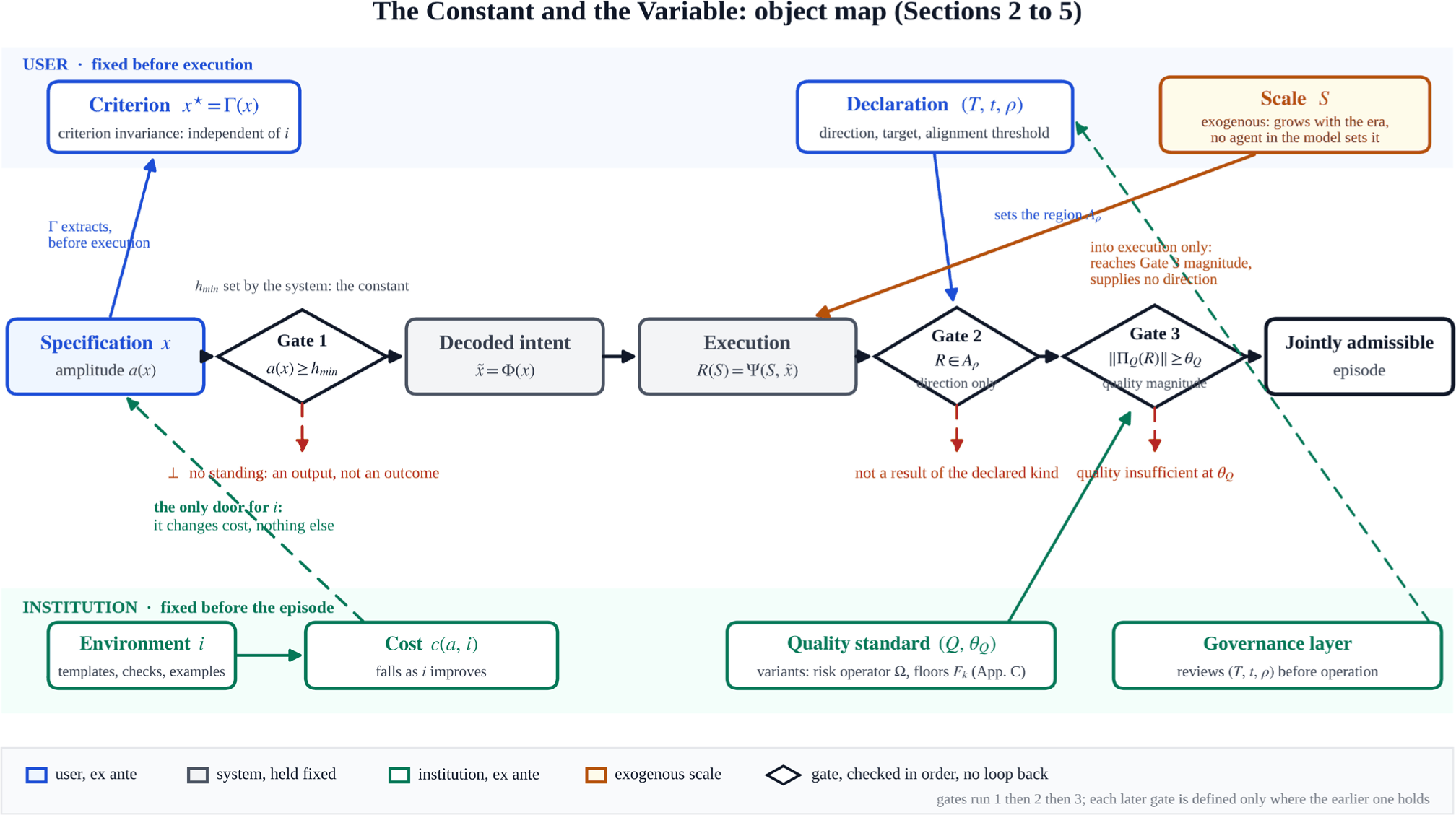
Three commitments organize what follows. First, evaluation runs through a three-gate structure: the user’s declared direction, not execution scale, fixes what kind of outcome counts as success. Second, each institution’s instruction support is represented by the distribution of instruction-environment quality across its episodes. Third, a comparative-statics bridge connects shifts in that quality to the cost the user faces at the micro level. The paper develops these in turn and examines their implications for governance, responsibility, and the design of human-AI joint systems. Appendix A consolidates notation, definitions, and assumptions, and maps the object system in Appendix Fig. A1.
2. Specifications, Amplitude, and Cost
We model a single human-AI interaction and place the variation on the human side. Throughout, we hold the decoding system fixed. By the decoding system we mean the parser, the validation rules, and the interpretation layer that turn a specification into usable intent. We do not study the case where the system itself becomes more capable; that is a separate question. Holding the system fixed does not freeze the user’s surroundings. The instruction environment in which a user produces a specification can still vary: the templates, guided fields, examples, and clarification available to them. Much of our analysis turns on this variation. Fixing the system has one consequence that the rest of the paper rests on. The standard a specification must meet to be reliably decoded is set by the system, and so it does not change within the analysis. The variable of interest is what the user supplies, and what supplying it costs.
Let x ∈ X denote the specification the user provides, including the goal, the constraints, the context, and the criteria for success. Throughout, the user is a role, not a fixed person: whichever party supplies the specification and the declaration in the episode at hand. A specification has two features we keep separate throughout. The first is how complete and well-formed it is, as an object. We capture this with a single number, its amplitude, written a(x). Amplitude does not record what the specification is about; it records how fully and clearly the specification is articulated, setting aside whether its content is correct or points in the right direction. A specification that states its goal, its constraints, and its success criteria in full has high amplitude; one that leaves them implicit or partial has low amplitude.
Formally, amplitude is a function
assigning each specification a non-negative number a(x). Two points matter for what follows. First, amplitude is a property of the specification itself, defined without reference to the environment in which it is later read. The same specification has the same amplitude whether the surrounding environment is rich or poor. Second, amplitude is a scalar, which is what lets us state admissibility as a threshold and compare specifications by how far they clear it. The single number does not record which element of a specification is missing; that loss is deliberate, since Gate 1 asks only whether the specification can be reliably decoded. What is missing shows up, if at all, in how the outcome fares at the later gates. Direction, what the specification aims at, is a separate matter, treated apart from amplitude.
Amplitude measures the specification, not the work the user does to produce it. The same specification can take more effort to produce in one setting than in another. We use effort informally for the user’s own time and energy spent in producing the specification; the specification cost defined below is its formal counterpart. The setting supplies no part of this effort; it only determines how much effort a given specification takes. To capture this, we introduce a second quantity on the user side, the specification cost, together with the environment it depends on. We write i > 0 for instruction-environment quality, a strictly positive scalar measure of how well the user’s surroundings support writing the specification. Those surroundings, the instruction environment, consist of the templates, guided fields, examples, and clarification mechanisms available while writing. Thus i summarizes, in a single ordered quantity, how much they reduce the cost that a given specification takes to produce. This concerns cost alone. A higher i makes a given specification cheaper to produce, and so lets the user state a given aim more fully. It does not change the aim itself. What the user is asking for, and which features of the outcome are at stake, are set by the user and do not vary with i. As with amplitude, treating i as a scalar is what lets us compare settings by how high i is and state the cost relations that follow.
The specification cost c is the cost needed to produce a specification of amplitude a in instruction-environment quality i, when the user works efficiently. A user who works inefficiently may spend more; c records this efficient cost, so that the cost is well defined as a function of the amplitude achieved. We write
and take it to be continuously differentiable, with
so that a more complete specification costs more to produce, while higher instruction-environment quality lowers the cost of producing any given amplitude. Cost and amplitude are distinct axes: amplitude records what the finished specification is, cost records what producing it took, and the two need not move together. Because cost rises strictly with amplitude at fixed instruction-environment quality, the relation can also be read in the other direction. For a given amount of cost, higher instruction-environment quality lets the user produce a more complete specification.
3. Admissibility and Its Cost
A specification is not used directly; it is read by the system and turned into usable intent. We call this decoding. Whether decoding is reliable depends on how complete the specification is: a fuller specification leaves less to guess, a sparser one more. There is a level of completeness below which the system cannot reliably recover the intended meaning. We write hmin for this level, the decoding bar, and state the admissibility condition, as
A specification meets this condition when its amplitude reaches the bar. We call such a specification admissible: structurally complete enough to be reliably decoded, which is a property of the specification, not of how much effort or execution follows it. Two features of hmin matter. First, it is strictly positive. A specification with no content cannot be reliably decoded into any particular intent, so the bar sits above zero: some minimum of completeness is always required. Second, it is constant in our analysis. Because the decoding system is held fixed (§2), the level of completeness it requires does not change as the user’s environment changes. The bar is set by the system, and the system is what we hold still. Instruction-environment quality, which varies, does not move the bar; what it moves is the cost of reaching it.
This already fixes a structural floor. Because the bar is a positive constant, every admissible specification requires the user to supply at least hmin of amplitude, whatever the environment. The environment lowers what that amplitude costs; the amplitude itself stays required. What the user must supply for an admissible specification is therefore bounded below by a fixed amount that the environment does not remove.
An admissible specification requires amplitude at least hmin, and producing amplitude costs effort. The cheapest way to be admissible is to produce exactly hmin: since cost rises with amplitude, any specification above the bar costs more than one at the bar. We write cmin (i) ≔ c(hmin, i) for the cost of producing a specification at the bar in instruction-environment quality i. It is the least a user can spend and still be admissible, so we call it the entry cost.
Because hmin is constant, instruction-environment quality enters the entry cost only through the cost of producing that fixed amplitude. Evaluating the cost assumption ∂c/∂i < 0 at a = hmin gives ∂cmin/i < 0.
The entry cost falls as instruction-environment quality rises. The bar stays exactly where it is, while the cost of clearing it goes down. This is the precise content of the claim that a better environment makes admissibility cheaper: the standard is unchanged, and what improves is the effort required to meet it.
The same fact can be read from the user’s side. Fix any cost level c̅ that the environment can realize, that is, a level in the range of c(⋅, i), and ask how much amplitude that cost buys. Because cost rises strictly with amplitude at a fixed environment, the cost function is invertible in amplitude. For each environment, a given cost corresponds to a single amplitude the user can produce, the amplitude at which cost equals c̅. Write this as a((c̅, i). The function a(c̅, i) is the inverse of c(a, i) in its first argument; we keep the letter a because its value is an amplitude, but it is not the amplitude map a(x). Raising instruction-environment quality lowers the cost of every amplitude, so the amplitude that a fixed cost can reach goes up:
The two statements are one fact seen from two sides. Holding amplitude at the bar and asking for its cost gives ∂cmin/∂i < 0: the same admissible specification becomes cheaper. Holding cost fixed at c̅ and asking for its amplitude gives ∂a(c̅, i)/∂i > 0: the same outlay produces a more complete specification. In both readings, the bar is fixed and only the cost relation shifts; what moves is never the standard, only the cost that meeting it requires.
This is what it means, in this framework, for a better environment to widen participation. Admissibility is unchanged, so the set of specifications that count as admissible is the same in a rich environment and a poor one. What changes is that clearing the fixed bar costs less, so a user spending any given cost reaches it in a wider range of environments. Participation widens not because the standard drops, but because the cost of meeting it does.
4. The Evaluation Objects
§3 fixed the condition a specification must meet to be decoded, and what meeting it costs. That condition is about the specification alone. The rest of the framework is about what the system then produces, the outcome, and how it is judged. Judging an outcome takes more than a single number: it takes a way to say where the outcome points and how good it is, measured against what the user fixed in advance. This section builds those objects, the outcome, the user’s ex ante criterion, and the two axes along which the outcome is read. Each is defined before it is used, so that what comes later rests only on objects already in hand.
Where amplitude a(x) measures the specification, the outcome is what the system produces from an admissible specification; §5.1 separates this from the bare output. We represent the outcome as a vector R in an evaluation space ℝd, and write ‖⋅‖ for the Euclidean norm and ⋅,⋅ for the inner product on ℝd. The coordinates of the evaluation space, and the units in which they are read, are fixed in advance and held fixed throughout. Representing the outcome as a vector, rather than a single number, is what lets us read two things off it separately: the direction it points and its magnitude on a given axis. How R is produced from the specification, through decoding and execution, is set out in Appendix B.1; here we need only that the outcome is a vector in ℝd.
An outcome is judged against a criterion that the user fixes before execution, not against the environment that produced it. From the specification x, a normative extraction map Γ builds this ex ante criterion,
Because i does not affect the aim or which features are at stake (§2), the criterion x* is immune to i. Γ reads the specification only through the aim and the features at stake, so its output inherits their independence of i. We record this as a named assumption, criterion invariance, rather than as a derived fact. The immunity is structural: if x* moved with i, the same environment would both set the standard and meet it. What i affects is the cost of reaching admissibility, and through that cost which specification the user can afford to write; it touches neither the decoding rule nor the criterion. The criterion is the user’s, fixed in advance. The outcome is read along two axes, carried by two subspaces of ℝd. The directional subspace T holds the dimensions the user takes to be at stake: what the outcome should be aiming at.
The quality subspace Q holds the non-directional standards the institution applies: how well-built the outcome must be, regardless of where it points. The two are orthogonal,
so direction and quality measure different things about R and cannot stand in for each other. This orthogonality is a design requirement on how evaluation is represented, not an empirical claim about existing schemes. The two subspaces need not span ℝd: components of an outcome outside both are read by no gate, and evaluation is deliberately confined to the declared and the institutional axes. The prior review of §5.2 is where this requirement on declarations is enforced. Let ΠT and ΠQ be the orthogonal projections of ℝd onto T and onto Q.
For any outcome R, then, ΠT (R) is its directional part and ΠQ (R) is its quality part. The user’s target direction is the criterion seen along the directional axis, normalized to unit length, t ≔ ΠT (x*)/‖ΠT (x*)‖, ‖ t ‖= 1, for ΠT (x*)≠0. We assume the user’s declaration carries a direction, so that ΠT (x*)≠0 holds and the target direction is well defined. Since x* is fixed in advance and free of i, so is t: the direction the user is aiming at is set before the outcome exists. Two thresholds complete the criterion. The user sets an alignment threshold ρ ∈ (0,1], how closely the outcome’s direction must match t. We take ρ to be strictly positive, because a declaration that tolerated orthogonal or opposed outcomes would not require the outcome to point toward the target at all, and the declaration is assumed to carry a direction. When the directional subspace is one-dimensional, every positive value of the alignment threshold yields the same admissible region: the outcomes whose directional component points along the target. The threshold then reduces to an orientation check. When the directional subspace has dimension at least two, we read the threshold as a graded tolerance. The institution sets a quality bar θQ > 0, how much quality magnitude the outcome must carry. The triple (T, t, ρ) is the user’s; the pair (Q, θQ) is the institution’s. The triple fixes when an outcome counts as pointing the right way. The outcome’s direction is ΠT (R)/‖ΠT (R)‖, and it points the right way when its alignment with t reaches ρ. We call the outcomes that meet this the directionally admissible region,
Membership in Aρ is a question of direction alone: it asks where R points, not how good it is. Quality is the other axis, read off the quality part ΠQ (R). The coordinates of Q are set up by the institution so that each quality dimension is measured on a nonnegative scale, with larger values meaning better built; deficits appear as small magnitudes, not as negative ones. We record this as a named assumption, the nonnegative quality convention. Where direction compares an angle, quality is a matter of magnitude: how much ΠQ (R) carries on the institution’s standards, with larger meaning better-built. The institution fixes a level θQ this magnitude must reach,
so an outcome meets the quality standard when its quality magnitude clears θQ. More fully, the institution may judge quality not by this aggregate alone but also by a floor on each dimension of Q that it evaluates, with safety-critical dimensions carrying higher floors. A high aggregate then cannot offset a low value on any single dimension. The main text uses the aggregate bar throughout; Appendix C.2 states the general form.
5. The Three Gates
§4 built the objects: the specification and its amplitude a(x), the outcome R, the user’s criterion x*, the user triple (T, t, ρ), and the institution pair (Q, θQ). An episode is judged by three conditions on these objects. We name them here and state each as a single condition. The three are checked in order, and each later one is defined only where the earlier one holds.
Gate 1 is the admissibility condition of §3, named. A specification clears it when its amplitude reaches the decoding bar,
Gate 1 is checked on the specification, before any outcome exists. Below the bar the system does not fall silent: it still produces an output. The two words are kept apart deliberately: an output is what the system produces, an outcome is what stands to be evaluated. What is missing is standing, not production. We write what the later gates receive as
where R is the outcome of §4.1, now licensed: with the bar cleared, the specification is reliably decoded, and what the system produces stands as the admissible outcome the later gates read. ⊥ marks the opposite state. It does not name the output, and it is not a second kind of outcome for the later gates to judge. It records that no reliable decoding stands behind the output, so there is no R for the later gates to read. This is why Gate 1 is first not only in order but in standing: the later gates judge R, and below the bar there is no R to judge, whatever the output.
Remark (the bar and the form of the output). Gate 1 places its condition on the specification, so ⊥ does not track the form the output takes. Below the bar the system may ask for clarification, it may hedge, or it may return a polished and confident product. Consider a request to improve a document that says nothing about what counts as improvement. The system may ask what kind of improvement is wanted, or it may return a fluent revision. The two outputs look nothing alike, and both episodes stand at ⊥, because in both cases the specification left no intent to be reliably decoded. The polished case deserves emphasis. A confident output looks like an admissible outcome, but there is no decoded intent for it to be faithful to, so we cannot even ask whether it is faithful. Standing comes from decoding, not from appearance.
Gate 2 is checked on the outcome R, once Gate 1 holds. It asks whether the outcome points where the user declared. The outcome clears it when its direction lies in the directionally admissible region of §4.2,
Gate 2 decides membership, not quality: an outcome outside Aρ is not a poor result to be weighed on its merits, it is not a result of the declared kind at all. Nor is an outcome outside Aρ the state that ⊥ records. Directional failure presupposes that Gate 1 holds and an outcome R stands to be judged; ⊥ marks the prior state, in which nothing stood. In deciding membership, Gate 2 is constitutive. It fixes what counts as an evaluable outcome, rather than rating outcomes already taken to be evaluable.
Remark (governance layer). Gate 2 takes the user’s declaration (T, t, ρ) as given and asks only whether an outcome conforms to it, not whether the declaration is itself acceptable. A declaration can be well-formed and still conflict with the institution’s substantive commitments, such as non-discrimination, patient safety, or due process. Judging the declaration itself is the task of a governance layer that reviews (T, t, ρ) before the episode enters operation, in forms such as ethics review, regulatory authorization, and institutional oversight. This layer sits above the operating gates. The framework treats it as a structural precondition and does not formalize its internal operation.
Gate 3 is checked on the outcome, once Gate 2 holds. It asks whether the outcome, being of the declared kind, is well-built on the institution’s standards. The outcome clears it when its quality magnitude reaches the bar of §4.2,
Gate 3 decides sufficiency: an outcome in Aρ that falls short of θQ is of the right kind but not good enough. This is the one gate that rates an outcome rather than admitting or excluding it. Because Gate 3 is asked only within Aρ, an outcome that fails Gate 2 is never weighed against θQ: the quality question does not arise for a result that is not of the declared kind. The single bar θQ on the aggregate magnitude is the simplest case. In safety-critical settings the institution may strengthen Gate 3, either by reshaping the bar into a risk-adjusted form or by adding floors on individual quality dimensions. Appendix C develops both and shows that each keeps Gate 3 a scalar sufficiency test in the same position and ordering. In those variants the institution fixes further parameters before the episode, the risk operator Ω with its threshold and the dimension floors Fk; the pair (Q, θQ) of §4.2 is its baseline standard.
An episode is jointly admissible when the three conditions hold in order:
The order is not a convenience. Gate 1 is checked before any outcome exists; Gate 2 and Gate 3 are checked on the outcome, first its direction, then its quality. The gates do not loop back: clearing a later one never reopens an earlier one. They sit at two layers, Gate 1 on the specification and Gate 2 and Gate 3 on the outcome, and are not merged into one. The user’s (T, t, ρ) and the institution’s (Q,θQ) are fixed before execution begins; Gate 2 applies the first, Gate 3 the second; and the orthogonality T⊥Q keeps direction and quality from standing in for each other.
6. Institutions and Participation
The structure so far describes a single episode: one user, one specification, one outcome. Institutions are made of many episodes, and they differ in the instruction-environment quality they provide. Across an institution’s episodes, the instruction-environment quality i is not one value but a spread, richer in some episodes and poorer in others. Let F summarize the distribution of instruction-environment quality by
the share of episodes whose instruction-environment quality is at least τ. As the threshold τ rises, fewer episodes satisfy it, so F is non-increasing in τ. The question is how an upward shift in instruction-environment quality changes who can participate, given that the decoding bar hmin stays fixed.
Suppose instruction-environment quality shifts upward across episodes: high values of i become more common and low values become less common. This is a statement about the entire distribution of i, not about a single summary statistic, and we make it precise through first-order stochastic dominance. Let F′ denote the distribution of instruction-environment quality after such a shift. Then, for any threshold τ, the share of episodes whose instruction-environment quality meets or exceeds τ is at least as large under F′ as under F,
This is more demanding than a comparison of averages: at every quality level, the share of episodes at or above that level does not fall.
The decoding bar does not move with the distribution; what moves is the cost of reaching it. By §3.2 the entry cost cmin (i) is strictly decreasing in i, so higher instruction-environment quality makes admissibility cheaper. Fix a user who can spend up to a maximum cost cmax, the most that user will spend in an episode. The user is admissible whenever the entry cost does not exceed this maximum,
In the notation of §3.2, the same condition can be read on the amplitude side: since cost rises strictly with amplitude, cmin (i)=c(hmin,i)≤cmax holds exactly when a(cmax,i) ≥ hmin. The user is admissible exactly when the amplitude their maximum cost can buy reaches the bar. Because cmin (i) decreases as i rises, the episodes satisfying cmin (i)≤cmax form an upward-closed set in i: whenever an episode qualifies, so does any episode with higher instruction-environment quality. An upward shift in the distribution of i therefore weakly increases the share of episodes in which the entry cost falls at or below cmax. Equivalently,
A user facing the same maximum cost cmax is admissible in at least as large a share of episodes under F′ as under F.
This is §3.2 viewed at the population level. The argument rests on one mechanism: an upward shift in the distribution of instruction-environment quality produces at least as large a share of episodes in which the required entry cost falls below a fixed maximum user cost. No parametric functional form is required beyond the monotonicity and regularity assumptions of §2. The result relies only on the monotone relation
together with a first-order stochastic improvement in the distribution of instruction-environment quality. Throughout, the decoding bar hmin remains fixed. Institutions do not widen participation by lowering the standard a specification must meet. They widen participation by lowering the cost of meeting that standard, so that the same maximum cost cmax is sufficient for admissibility in at least as large a share of episodes. What shifts is the cost, not the bar. Participation here refers to this episode-level feasibility for a given user; decisions about uptake lie outside the model.
7. Direction under Amplification
The three gates fix when an episode is admissible. They say nothing yet about scale: how the picture changes as the system executes more. This section adds that variable and asks a single question. As execution grows, which of the three gates does it relax, and which does it leave untouched? The answer is not symmetric, and the asymmetry is the paper’s main point: scale reaches one gate and not the other two, so growing execution cannot replace what the user supplies.
Through §5 the outcome R was a single fixed result. But the system can execute the same decoded intent at different magnitudes: more compute, more parallel attempts, longer runs, under a fixed execution protocol. We capture this with a single scalar, the execution scale S > 0, and from here write the outcome as R(S) to mark that it depends on S. Larger S means more execution applied to the same specification. The three conditions of §5 are unchanged in form; what changes is that the outcome they read now moves with S. How R(S) is produced from the specification and S is set out in Appendix B.1; here we need only how each gate responds as S grows.
Take the three gates in turn and ask how each responds as S grows. Gate 1 does not move. Its condition, a(x) ≥ hmin, is about the specification, and the specification is fixed before any execution begins. Scale acts on what the system does with the decoded intent, not on the specification itself, so no amount of S changes whether the bar is cleared. Gate 1 is settled before S enters.
Gate 2 does not move either, for a different reason. Its condition, R ∈ Aρ, is about direction: whether the outcome points where the user declared. Scale produces more of an outcome, but more of it is not a direction for it. A larger S can make the outcome bigger without aiming it at t; an outcome pointed the wrong way stays misaimed no matter how large it grows. Direction is set by the user’s declaration (T, t, ρ), and execution does not supply it. Appendix B.3 states the quantitative form of this claim. Under the regularities of B.2, the Gate 2 verdict is independent of S outside a band around ρ whose width is set by the audited error bound (B.3).
Gate 3 is the one gate scale reaches. Its condition is on quality magnitude: whether the outcome is well-built on the institution’s standards. Magnitude is what execution adds. Applying more execution to the same decoded intent raises the quality the outcome carries, so the quantity Gate 3 measures, ‖ΠQ (R(S))‖, grows with S on the operating range of Appendix B.2, up to the audited relative error. An outcome that falls short at low scale can clear the bar at higher scale. One limit remains even here: scale lifts the magnitude only if the decoded intent carries a quality component to lift. If the decoded intent carries nothing on Q, more execution scales nothing, and Gate 3 stays unmet at every S.
§7.2 found a split: of the three gates, scale moves only Gate 3, and leaves Gate 1 and Gate 2 where they were. Two limits follow.
The first is on amplitude. Gate 1 holds before execution begins, and the bar hmin is a fixed positive constant. So, however large S grows, the user must still supply a specification that reaches hmin: scale does not lower the bar. There is always a minimum specification, and it is the user who supplies it. Growing execution does not relieve the user of it.
The second is on direction. Gate 2 holds or fails on where the outcome points, and scale adds magnitude, not direction. More execution makes the outcome larger, not more aligned; an outcome aimed where the user did not ask stays misaimed at every S. The direction is the user’s declaration (T, t, ρ), fixed before any execution. No matter how much execution is added, it cannot replace the direction the user set.
The two limits land in the same place. What scale cannot reach, the user must supply: the minimum specification at Gate 1, and the direction at Gate 2. Within the operating range of Appendix B.2, scale lifts quality magnitude, and it still leaves both of these with the user. This is the sense in which amplification does not remove the user’s responsibility but isolates it: as execution grows, the gates it cannot move are exactly the ones the user is answerable for. This step from structure to responsibility rests on one normative premise, stated openly: a party is answerable for what it alone sets and what no other part of the system can supply or revise. The framework adopts this premise rather than deriving it. Under it, the user is answerable for the declaration and the minimum specification, while the governance layer of §5.2 carries the distinct responsibility of testing the declaration before operation (§8.2, §9.2.2); responsibility for the declaration does not exhaust responsibility for the deployment. The quantitative form of the binding requirement, and how it behaves as S grows, is given in Appendix B.3.
This asymmetry has a close counterpart in alignment research, where added capability does not secure the intended objective: an agent can retain competence while pursuing the wrong goal, and stronger optimization can improve a proxy objective while the intended outcome worsens (Di Langosco et al., 2022; Pan et al., 2022). Those results concern learned or supplied objectives in reinforcement-learning settings. Here, by contrast, the direction is the user’s ex ante declaration in a single episode, and scale is execution magnitude applied to the decoded intent. Relocating the asymmetry to the human-AI episode, and making it structural through the gates, is what the present treatment adds.
8. Practical Implications
As execution becomes automated, the scarce skill shifts upstream. What the system does with a specification is increasingly handled by the system; what still varies, and still decides the outcome, is the specification the user supplies. The skill that matters is therefore the construction of specifications. This means stating the goal, the constraints, and the success criteria completely enough to clear the decoding bar (Gate 1). It also means declaring the direction precisely enough that the outcome lands where the user intends (Gate 2). Two users of the same system can get very different results, not because one executes better, but because one supplies a specification that is more complete and more clearly aimed. For training in educational, professional, and public-service settings, the core skill is no longer fluent text production. It is, rather, the ability to say what the work is for, what must not happen, and how success will be judged.
The same threshold logic shapes who can participate. §6 showed that a better instruction-environment quality does not lower the fixed bar but lowers the entry cost of clearing it. Inclusive design works on that cost. Guided input fields, ambiguity checks, and standardized templates lower the entry cost cmin (i), so that a user spending a given amount reaches the bar in a larger share of episodes. This lever does not touch the standard. This is what separates inclusive design from dilutive design. Inclusive design lowers the cost a user faces in clearing the fixed bar. Dilutive design, by contrast, would weaken the standard itself by lowering the decoding bar at Gate 1, so that less complete specifications are admitted.
Consider two researchers using the same generative AI system to develop a research proposal for a human-subject study. One works at an institution that provides standardized Institutional Review Board (IRB) templates tailored to different categories of research, together with examples, checklists, and procedural guidance. The other works at an institution where the relevant information is available only through fragmented, less systematically organized materials. Suppose both face broadly similar IRB expectations; the difference lies only in instruction-environment quality i. At the institution with standardized templates, the researcher receives clearer guidance on formulating research questions, describing study procedures, specifying risks and benefits, and documenting safeguards. The proposal they can write at a given cost is more complete, that is, higher in amplitude a(x); equivalently, the decoding bar is reached at a lower entry cost cmin (i). At the institution relying on fragmented materials, the researcher must spend more to identify what information is required, locate relevant guidance, and determine how it should be expressed. As a result, the same decoding bar hmin is reached only at a higher cost.
In domains where errors carry serious consequences, such as healthcare, finance, employment, or public infrastructure, the gate structure points to one place. Gate 2 takes the user’s declaration (T, t, ρ) as given and checks conformity to it. By the asymmetry of §7, growing execution scale S cannot supply or correct direction. It only enlarges whatever the declaration admits. A badly set declaration therefore scales into large harm, and the failure is not performance below a threshold. It is the declaration itself being set wrongly, so that outcomes the institution should never accept count as exactly what was asked for. And because operation checks conformity to the declaration, nothing inside operation revises the declaration itself. Responsibility sits at the moment of declaration, and correction must come before operation, not during it.
That prior position is the governance layer of §5.2, and it functions as the precondition on which Gate 2 rests. Gate 2 can take (T, t, ρ) as given only because a layer above it has already judged that this declaration may enter operation at all. For the layer to bear that weight, the declaration must be documented, auditable, and stable, and the procedures that produce and revise it must themselves bear scrutiny.
Consider a company that brings a generative AI system into a personnel management project, screening and evaluating its workforce. Seeking to push out its older staff, the company declares a direction (T, t, ρ) that places age among the scored dimensions of T and weights t so that younger employees rank higher. The declaration makes discrimination the objective. Under the declaration, outcomes that disadvantage older employees are exactly what was asked for. An outcome conforming to it clears Gate 2, and by the asymmetry of §7 no execution scale turns that direction legitimate. What stops it sits above operation. The governance layer of §5.2 reviews the declared (T, t, ρ) before any episode runs, here through the company’s compliance and legal review under age discrimination law. The review examines which dimensions T includes, what weight t places on each, and how much room ρ leaves. Finding that the declaration targets a characteristic the law protects, the layer does not permit it to enter operation and returns it for revision. The filtering happens at the declaration, before any episode runs, which is the only place it can happen.
One might object that the system itself, tuned toward safe behavior, will soften or refuse the age-based ranking the declaration asks for. Such behavior changes what is produced, not what counts. The declaration is fixed before execution, so the system can shape the outcome R, but it cannot alter T, t, or ρ. The same declaration still targets the discriminatory outcomes; a softened or refused output may simply fail Gate 2 under it, and whatever does clear Gate 2 is credited as on target. Protection that depends on which point in Aρ the system happens to produce is unstable across models, versions, and episodes. It is recorded nowhere in the declaration and, unless separately governed, answers to no prior review; it can supplement, but cannot replace, that review. The governance layer puts the protection where it can be reviewed: in the declaration itself.
The safeguard in high-stakes deployment is therefore joint. A well-set Gate 2 without an effective governance layer is fragile, since nothing inside the operation prevents the declaration from being set wrongly to begin with. A governance layer without Gate 2’s anchored declaration has nothing structural to review. Together they form the safeguard. Either alone is insufficient. The risk diagnosis above applies where the layer is absent, weak, or has failed, and the asymmetry of §7 offers no compensation for that failure. The framework treats the layer’s operation as a structural precondition and leaves the design of its review and accountability mechanisms to future work.
9. Realism, Implementation, and Research Seeding
A recurring concern with abstract models of human-AI interaction is whether they describe anything that exists outside theory. The present framework is built to avoid that gap: its core objects correspond to institutional structures already in operation, and each correspondence seeds an independent line of research.
First, instruction-environment quality i is not a latent psychological variable but the degree to which the surrounding materials supports the user in writing a specification. These supports include templates, guided fields, examples, ambiguity checks, and standardized vocabularies. They are already deployed in clinical documentation, regulatory compliance, procurement, and annotation pipelines. Treating i as a structured institutional variable makes these design choices objects of formal study. And since an institution’s episodes carry a distribution of i, the F of §6, institutional design becomes a question with a definite shape. The open questions are which interventions shift F upward, and how far the shift travels into entry costs and participation.
Second, the decoding bar hmin formalizes a familiar but under-theorized boundary: the minimum completeness below which a specification is not usable, whatever the system then produces. In the framework the bar belongs to the decoding system and does not move with the environment. What varies across organizations is the cost of reaching it, cmin (i), borne in practice as the effort whose required amount templates and checks either reduce or leave with the user. Two empirical objects follow. One is the bar itself, located, for a given system, at the point where specifications begin to be reliably decoded. The other is the entry cost, measured across environments as the effort a usable specification requires under different scaffolding regimes. The framework’s separation is itself testable: holding the system fixed, improvements in the instruction-environment quality should appear in measured costs, not in where the bar sits (§3, §6).
Third, the threshold form of participation yields a sharp prediction: usability should turn on clearing the bar rather than rise smoothly with better instructions. Modeling participation through a(x) ≥ hmin renders this discontinuity directly. It also invites work on scaling and on the risks that arise when execution capacity grows faster than the scaffolding that supports admissible specification. The two grow on different engines: execution capacity grows with the era, while the scaffolding grows only where an institution builds it. When the first outruns the second, the share of episodes a user can afford stands still, and a badly set declaration is carried at a larger scale (§6, §8).
Fourth, the three-gate structure of §5 corresponds to sequential evaluation practices in regulated settings. A medical diagnostic system is categorized within a condition class before its accuracy is assessed. A financial report is verified for required disclosures before substantive review. A compliance submission is checked for inclusion in the regulatory domain before its content is examined. Failure at a prior gate terminates evaluation rather than producing an unfavorable judgment within it, and each gate is verified at its natural layer, which makes each empirically tractable through existing audit and regulatory mechanisms.
Fifth, the governance layer of §5.2 corresponds to review mechanisms that already operate before deployment in regulated settings. Ethics committees vet protocols before clinical AI enters use. Regulatory bodies examine intended-use statements before market authorization. Boards, in turn, assess whether a proposed deployment’s evaluable domain aligns with the institution’s substantive commitments. Treating this prior review as a distinct meta-level on the acceptability of the declaration (T, t, ρ) opens research on several questions. These include how such review should be constituted, what standards of documentation and auditability it should enforce, and how its effectiveness can be evaluated independently of downstream system performance. The direction is salient because, by the asymmetry of §7, no operating-gate correction revises an unacceptable declaration; the corrective burden sits on prior review (§8.2).
Finally, ex ante evaluation criteria reflect existing practice rather than a theoretical ideal. In regulated environments, criteria are declared in advance as predefined acceptance criteria and scoring rubrics, and outcomes are assessed against them rather than used to redefine them. This is the independence that the criterion of §4.2 requires. The scaling regularities on which the bounds of Appendix B.3 rest are likewise auditable. On a reference sample of admissible episodes, deviations from the nominal scaling relations give institutions an empirical check on the assumed regularities. The audit quantities are stated in Appendix B.4. This opens research in AI governance, accountability, and the political economy of evaluation standards.
Because the core constructs map onto existing institutional mechanisms, researchers can extend, contest, or reinterpret specific components without adopting the entire framework. The contribution is thus not only a closed theoretical argument but the seeding of a broader research ecology around institutional decoding (how institutions make reliable decoding affordable), threshold governance, and admissible human-AI collaboration.
To anchor the three-gate structure in concrete institutional settings, we present two stylized case observations. These are not empirical validations but illustrative reconstructions, showing how the gates of §5, in their order, map onto distinctions already operative in regulated practice.
Deployment of AI-enabled radiology devices under Software as a Medical Device regulation offers an illustrative mapping of the three gates. The regulatory frame includes premarket pathways such as 510(k), the AI/ML Software as a Medical Device (SaMD) Action Plan (U.S. Food and Drug Administration, 2021), the guidance on predetermined change control plans (U.S. Food and Drug Administration, 2025), and the clinical-evaluation principles for SaMD (International Medical Device Regulators Forum, 2017). The last of these asks three questions in order: whether there is a valid clinical association between the output and the targeted clinical condition, whether the software correctly processes input data to generate accurate, reliable, and precise output, and whether use of that output achieves the intended purpose.
Gate 1 has its regulatory counterpart in analytical validation. The requirement is that the software correctly and reliably processes the input it is given, which presupposes that the input is well enough formed to be processed. The guidance does not say what a well formed input contains, and each deploying institution settles that for itself. A radiology service that implements the requirement therefore fixes the imaging protocol, the acquisition parameters, and the clinical question before a study is sent to the device, because the device was validated only for inputs of that kind. These are institutional implementations of a regulatory requirement rather than named regulatory criteria, and the decoding bar is our name for the level at which they are set.
Gate 2 has its counterpart in the intended use, the targeted clinical condition, the target population, and the conditions of use. A device cleared for one purpose is not evaluated on another, and outcomes outside that purpose fall outside the evaluation entirely. The declaring user here is the deploying entity, the manufacturer or the clinical institution acting as principal. Reading the declared triple onto these regulatory objects is our interpretation and not a regulatory equivalence.
Gate 3 has its counterpart in clinical validation against acceptance criteria that are fixed in advance, using measures such as sensitivity and specificity. The guidance on predetermined change control plans asks for such criteria to be predefined and for evidence that any modification preserves safety and effectiveness across the intended-use population. These standards are set at the level of the device and its reference population rather than for a single episode, so the per-episode quality bar is an analytical counterpart rather than a regulatory term.
Above these gates, premarket review operates before deployment. The regulator examines the intended use before the device enters the market, and this is the working counterpart of the governance layer whose failure defines Case 2. Ethics review plays a comparable part in research use, although the cited device guidance does not establish it as a general condition of market authorization.
The Australian Robodebt Scheme, implemented from 2015 and continued through 2019, later became the subject of the Royal Commission into the Robodebt Scheme (2023). It provides the contrast. Where Case 1 presents an illustrative mapping of declaration, review, and operating evaluation, Robodebt shows what can follow when an unlawful design enters operation without effective prior legal review. The lesson the framework draws from it concerns the governance layer.
Two points about the Scheme are supported by the Commission, and the framework reads them in a definite order. The first concerns the declaration. As the declaring user, the deploying agency had to fix (T, t, ρ) before operation. In the framework’s reconstruction, the lawful target was the recovery of genuine overpayments established under social security law. The Scheme instead treated employer-reported income, averaged across fortnights and often unconfirmed by the employer or recipient, as a sufficient basis for raising debts. The Commission found that this method did not accord with the statutory use of actual fortnightly income and that the Scheme was “devised without regard to the social security law” (Royal Commission into the Robodebt Scheme, 2023, Executive Summary). The description of this failure as a wrongly set declaration is the paper’s interpretive mapping, not the Commission’s terminology.
The Commission also documented repeated legal warnings that were not acted on. Internal advice in 2014 identified inconsistency between income averaging and the legislative framework. Draft external advice in August 2018 concluded that averaging employer-reported income was not permissible and should have prompted immediate suspension or further advice from the Solicitor-General, but it was neither finalized nor acted on (Royal Commission into the Robodebt Scheme, 2023, Executive Summary). In the framework’s terms, this supports the narrower claim that the governance layer, here prior legal review, failed before operation. The further proposition that no operating gate could have corrected the declaration is a deduction from the framework, not a finding made by the Commission.
The second supported point concerns the later contestation episode. Recipients bore the onus of contradicting asserted debts by reconstructing actual earnings for periods extending as far back as five years, although official guidance had said that payslips needed to be retained for only six months. The Commission also documented difficulty obtaining records, upload problems, enforced reliance on an online portal, limited digital access and literacy, and information that was difficult to understand (Royal Commission into the Robodebt Scheme, 2023, Executive Summary; Chapter 10). In the framework’s reading, these conditions raised the entry cost cmin (i) of an admissible contestation and could leave the attainable amplitude a(x) below hmin. The Commission did not estimate these formal quantities or show that the entry cost exceeded every affected person’s maximum. The Gate 1 description is therefore an interpretive reconstruction of documented evidentiary and access barriers.
These are the two conclusions the framework can draw with qualified confidence: an unlawful design that should have been stopped by prior legal review, and a later contestation process burdened by severe evidentiary and access barriers. The Commission’s broader judgment that the Scheme was neither fair nor legal concerns substantive law and administration beyond what the framework itself establishes. The framework’s claims here are narrower and explicitly interpretive.
The contrast between the two cases fixes the framework’s diagnostic use. Case 1 shows the declaration, the review above it, and the operating gates working as distinct layers. Case 2 shows what follows when a declaration is set wrongly and the governance layer above it does not test the declaration before operation. The review that should have been a precondition arrived only afterward, in the form of the Royal Commission. It offered diagnosis rather than prevention. The framework locates the failure there, at the declaration and the review owed to it, not in the operating gates, which can only enforce the declaration they are given. Because the framework was developed independently of both cases, this retrospective reading is constructive rather than predictive: it shows that the framework’s distinctions track the institutional distinctions that regulators and inquiries themselves draw. Prospective validation through deployment studies remains future work.
10. Conclusion
This paper presented a compact lens for a shift in human-AI collaboration. As the cost of execution falls, the binding constraint on cognitive production moves upstream to the specification the user supplies and to the institutional conditions under which it can be supplied.
At the level of a single episode, the framework separates the objects that this shift makes load-bearing. A specification x carries an amplitude a(x), its completeness. The decoding bar hmin is a fact about the decoding system and does not move with the instruction-environment quality. What the instruction-environment quality i moves is the cost, with the entry cost cmin (i) falling as i rises (§3). Evaluation rests on a criterion fixed before execution, x*=Γ(x), independent of the instruction-environment quality. It also rests on two orthogonal axes, the user’s directional subspace T with target t and the institution’s quality subspace Q with bar θQ (§4). Three gates then run in order (§5). Gate 1 is checked on the specification, a(x) ≥ hmin, with ⊥ marking that below the bar the system’s output has no reliable decoding behind it. Gate 2 is checked on the outcome, R ∈ Aρ, and is constitutive: it fixes what counts as an evaluable outcome at all. Gate 3 is checked on the outcome within Aρ, ‖ΠQ (R)‖ ≥ θQ, and decides sufficiency. The gates carry two kinds of primacy that do not compete. Gate 1 is first in order and in standing, since below the bar no admissible outcome arises. Gate 2 is constitutive of evaluability on the outcome. Above the operating gates sits the governance layer, which reviews the declaration (T, t, ρ) before any episode runs (§5.2).
At the level of an institution, the same cost mechanism reads as a statement about participation. An institution carries a distribution F of instruction-environment quality across its episodes. A first-order upward shift in F makes low entry costs more common, so the same user, spending no more, clears the same bar in at least as large a share of episodes (§6). Institutions widen participation by lowering the cost of meeting standards, not by lowering the standards.
The central implication is governance-oriented. Execution scale reaches exactly one gate (§7). Gate 1 is settled before scale enters. Gate 2 is unmoved by it: for a fixed declaration, no value of S, no level of a(x), and no improvement in i modifies the directionally admissible region itself. Outside the audit margins of Appendix B.3 the verdict R(S) ∈ Aρ is likewise independent of S. Only Gate 3’s quality magnitude grows with S, up to the audited error band. Two limits follow. There is always a minimum specification, bounded below by a fixed bar that neither scale nor instruction-environment quality moves, and there is always a direction, which execution cannot supply. Both sit with the user under the responsibility premise of §7.3, and growing execution does not dilute this responsibility but isolates it. In high-stakes deployment the practical consequence is a joint safeguard: a declaration anchored at Gate 2 and a governance layer that reviews it before operation (§5.2, §8.2).
These distinctions are not a theoretical imposition. Regulated clinical AI deployment illustrates the three gates at their natural layers. The Robodebt scheme shows what that layering prevents: a declaration set wrongly and never tested by the review owed to it before it entered operation (§9.2). The framework formalizes distinctions that institutional practice already draws, often implicitly, when it diagnoses success and failure in AI-mediated work.
The order of exposition has not been incidental. The extended treatment of cost and instruction-environment quality was needed to fix exactly what i and S reach and what they do not. They reach the cost of admissibility and the quality an outcome carries. They reach neither the bar nor the constitutive layer at which the evaluable domain is declared. The irreducibility of that declaration becomes visible only once the reach of everything else has been stated in full. What remains outside that reach is not a residual detail but the place where the human contribution is structurally anchored. And because the framework’s constructs map onto measurable institutional objects (§9.1), its thresholds and comparative statics are open to test rather than left as rhetorical claims.
“The aspects of things that are most important for us are hidden because of their simplicity and familiarity.”
Ludwig Wittgenstein, Philosophical Investigations, §129 (Wittgenstein, 1958).
Anticipated Objections and Responses
The framework advanced in this paper invites, and indeed anticipates, a number of serious objections, and we are grateful for the occasion to address them. What follows is not offered as a defensive postscript but as an attempt to engage, with the seriousness they deserve, the concerns that a careful and fair-minded reader might raise. Some touch the conceptual foundations; others the formal apparatus or the scope of application. One further objection of a practical kind, namely that the system itself may supply what a declaration omits, arises inside deployment and was answered where it arises (§8.2). For the objections below, which are structural and conceptual, we try to say plainly where our commitments are strong, where they are deliberately bounded, and where further work is needed.
A natural first response to this paper, and one we expect many readers to share, is that its mathematical apparatus is out of proportion to the phenomena it addresses. One might argue that the essential insight, that specification quality matters more than execution capacity in AI-mediated work, is already widely appreciated in applied AI research. On this view, the insight does not require an amplitude with a decoding bar, a cost function, three gate conditions, projections onto two subspaces, and a stochastic-dominance argument. We concede at once that this objection is not without merit. The intuition itself is not novel, and the reader is entitled to ask whether the formalization adds value beyond what plain language could achieve.
Our reply rests on a distinction between intuition and structural precision. Many claims in the human-AI interaction literature remain, through no fault of their authors, at the level of heuristic observation: that prompts matter, that context shapes output, that alignment is important. These statements are directionally correct but analytically incomplete. They do not say where control is exercised, what determines participation, or how institutional conditions mediate the crossing of thresholds. We do not offer the formalism to impress; we offer it to discipline. By fixing definitions, separating what a specification is from what producing it costs, and deriving comparative statics from explicit assumptions, the framework makes its empirical claims falsifiable, which informal treatments typically do not. It is precisely because the core intuition is so widely shared that we believe its formal articulation earns its keep. Shared intuitions, left unstructured, tend to proliferate interpretations that are mutually inconsistent. We would rather be refutable than vague.
A reader working in the situated-action tradition would object that a scalar representation cannot capture how meaning is actually produced, since understanding in real interaction emerges from circumstances as they arise, from mutual interpretation, and from repair when interpretation fails. The same objection extends to the outcome side. Outcomes are not literally vectors, conformity to a goal is not literally a cosine, and a single threshold may appear too thin to carry normative judgment.
We would ask such readers to regard these objects as operational proxies rather than as cognitive models, and we hope to show that the claims carrying weight do not depend on their fine structure. The scalar a(x) captures the degree to which a specification suffices for reliable decoding, not the semantic content of an intention; direction and quality are handled separately, through the criterion x* and the two axes. On the outcome side, what the argument uses is modest. It uses only that membership and sufficiency are different questions, with (T⊥Q) keeping the two evaluated components from standing in for each other, that the criterion is fixed before the outcome (§4.2), that the gates run in order (§5), and that scale reaches only quality magnitude (§7). The separation itself depends neither on dimension counts nor on the cosine form in particular, though the graded reading of the alignment threshold turns on dimension (§4.2); Aρ stands in for any operationalization of a declared direction that is fixed ex ante. As for the apparent arbitrariness of ρ, we would respectfully suggest that it is not a defect. The threshold ρ is declared, not derived, and that is what makes it the user’s to own and the governance layer’s to review (§5.2, §8.2). We readily grant that a richer model of pragmatics and situated meaning would enrich the framework, and we would welcome such work. In the meantime, we ask that a(x) be read as a placeholder awaiting disciplinary refinement, not as a final word on the nature of specification.
Many readers may fairly object that the model looks static where practice is iterative: real use is dialogic, users refine their specifications across turns, and an ex ante declaration may seem to misdescribe the work.
Our reply is that iteration is a sequence of episodes, and that the declaration constraint binds each episode, not the user’s learning across them. Nothing in the framework forbids revising (T, t, ρ) between episodes, and we would not wish it to. A revised declaration enters the next episode ex ante and passes through the same procedures of review and revision (§5.2, §8.2). Revision is welcome. The one thing the framework does not allow is fixing the criterion after seeing the outcome it is meant to judge. The criterion for each episode must be set before that episode’s outcome, and repeating the work across episodes does not change this (§4.2).
Many readers may object that direction and quality cannot, in practice, be cleanly separated: what counts as well-built often depends on what the work is for, so T⊥Q may strike the reader as unrealistic. We acknowledge that many existing evaluation schemes do, in fact, entangle the two.
Our reply is that the orthogonality is offered as a design requirement on evaluation, not as an empirical claim that every existing scheme satisfies it. It asks that evaluation be built so that the two questions cannot substitute for each other. Where criteria entangle, we do not deny the entanglement; rather, we ask that it be recognized as a defect.
Perhaps the most philosophically ambitious objection, and the one we have weighed most carefully, challenges the paper’s foundational commitment that the setting of ends, values, and normative constraints remains anchored in human agents. Bostrom’s orthogonality thesis holds that intelligence and final goals may vary independently across possible artificial agents, while his instrumental-convergence thesis allows sufficiently capable agents to pursue common intermediate goals in service of many different final goals (Bostrom, 2012). A critic might therefore argue that advanced AI could develop or approximate goal-setting capacities that make the human-anchoring assumption obsolete.
We do not presume to deny the theoretical possibility. We claim less: that under current and foreseeable architectures, deployed systems do not generate intrinsic ends; they optimize objectives supplied externally, and the framework is constructed for this operating regime. Our own machinery states the structural version of the point. A system can add content to the outcome, and it routinely generates subordinate goals, decomposing tasks and structuring execution. Within an episode, however, it cannot add a dimension to T, weight to t, or strictness to ρ (§8.2). So what stays with humans is not every goal-related activity, but the first step: choosing the ends. The subordinate goals an AI generates are valid only because they serve those human-set ends, and whoever sets the ends is the one answerable for them on review (§5.2).
Should the empirical landscape change in ways that confer autonomous end setting on AI systems, we would be the first to grant that the framework’s allocation of responsibility requires fundamental revision. Until then, treating the human declaration as the source of direction is a modeling choice that reflects the actual structure of deployment, not an assertion that machine end setting is impossible. A further commitment motivates the paper, though the framework does not depend on it. On this commitment, the anchoring of human responsibility should be preserved as a permanent structural principle, not treated as a temporary feature of current AI architectures. The framework’s main claims still hold under the weaker, operational reading. The stronger, normative reading we leave, respectfully, to the reader.
A sociotechnical critic might argue that treating institutional conditions as parameters abstracts away the social actors, institutional settings, and contested values that shape the system (Selbst et al., 2019). A related objection from work on automated welfare administration is that such systems fall hardest on those least able to contest them, so that questions of political economy and distribution cannot be treated as parameters at all (Eubanks, 2018). Who designs the instruction environments, whose specifications count as legitimate, and how standards are set are questions of power and distribution. On this view, the framework may depoliticize a political process.
We acknowledge the force of this concern, and we answer it by pointing to where these questions live inside the framework. Instruction-environment quality makes visible that the conditions of legibility are not a natural given but a product of organizational and governance choices. §6 makes the distributive question statable, since the distribution of i across an institution’s episodes sets the entry cost and so determines who can participate. The distinction between inclusive and dilutive design (§8.1) separates widening participation from weakening standards. The political questions proper, who exercises the governance layer, how it is constituted, and whose voices it represents, attach to that layer (§5.2). There, the acceptability of a declaration against the institution’s commitments, including non-discrimination and the protection of disadvantaged groups, is decided before operation (§8.2). The asymmetry of §7 does not insulate the user from accountability for what is declared; it locates that accountability at the prior review. We do not develop a theory of how those choices are made, or in whose interest. We name this as a real limitation, offered as an invitation to political economy and science and technology studies rather than as an oversight.
The foregoing objections are, in our estimation, among the strongest that can be raised against the paper’s central claims, and we are indebted to them. That they can be articulated precisely is itself a consequence of the formal structure, for a theory that cannot be clearly opposed says very little. Our ambition has not been to foreclose debate but to offer a structure well defined enough that debate can proceed on shared ground. We will count the paper successful if its critics find it worth refuting.
In Practice
Generative AI is being deployed into high-stakes decision-making faster than institutional, regulatory, and organizational vocabularies can absorb the change. The question is no longer whether AI systems will enter benefits adjudication, clinical documentation, compliance workflows, educational assessment, and public-service delivery. Both case observations of §9.2 concern automated decision systems entering such settings, one where the prior review held and one where it failed. In the first, the declaration and the review above it are enforced as distinct layers. In the second, a declaration was set wrongly and the review owed to it never tested it before operation. The question is whether the institutions receiving these systems can say, with enough precision, what is being deployed, what counts as an admissible use of it, and where responsibility sits when it fails. The framework developed in this paper is offered as one contribution to that articulation, addressed to two classes of institutional decision-makers whose work has come to depend on AI-mediated systems.
For policymakers and governance bodies, the gate structure gives a formal account of why execution scale does not substitute for what the user supplies. By the asymmetry of §7, scale raises only the quality magnitude at Gate 3. It moves neither the bar at Gate 1 nor the direction at Gate 2. Governance designed around output magnitude alone, measuring success by throughput, coverage, or response time, therefore leaves the constitutive question untouched: which outcomes were admitted into evaluation in the first place, and against what declaration. The framework locates the audit point upstream, at the ex ante declaration that fixes the evaluable domain, and at the governance layer that reviews this declaration before any episode runs (§5.2, §8.2). A confident output is not yet an admissible outcome; standing comes from reliable decoding at Gate 1 (§5.1). And an admissible outcome is not yet an authorized one: the declaration fixes the evaluable domain, and the governance layer licenses that declaration to enter operation by testing it before any episode runs (§5.2, §8.2). Where that prior review is absent, there is nothing for evaluation to stand on. The Robodebt reconstruction records what follows when a wrongly set declaration enters operation unreviewed (§9.2.2).
For organizations deploying AI-mediated cognitive work, the separation of the bar from the cost provides a diagnostic for where to invest. The decoding bar belongs to the system and does not move with the surroundings; what an organization controls is the entry cost its people face in clearing it (§3). Many organizations experience a familiar pattern: AI tools are introduced, throughput rises, and yet results disappoint as correction cycles and rework accumulate. The framework offers one diagnosis: an under-invested instruction environment. Episodes run on specifications too thin to be reliably decoded, so what the system produces, however fluent, has no decoded intent behind it. The remedy is not more execution capacity, which moves only Gate 3. It is investment in the instruction environment, the templates, guided fields, examples, and clarification that lower the cost of an admissible specification. It is also investment in training that treats the construction of specifications, stating the goal, the constraints, and the success criteria, as the core upstream skill (§8.1).
These are not applications the paper performs. They are vocabularies the paper makes available. And because the constructs they name correspond to measurable institutional objects, each vocabulary comes with an empirical handle. Those objects are the bar located for a given system, the entry cost measured across environments, and the distribution of instruction-environment quality observed across an institution’s episodes (§9.1).
The paper deliberately refrains from several things. It offers neither a predictive model of AI capability trajectories, nor specific policy prescriptions, nor advocacy for or against any particular technology. These omissions are intentional. The purpose is diagnostic and structural. Its first aim is to identify the variables that determine whether human-AI collaboration produces outcomes that are not merely large, but admissible, directed, and accountable. Its second aim is to locate the responsibility that stays with the user, for the minimum specification and for the direction, even as execution scales and environments improve. In an era when public discourse about AI oscillates between uncritical enthusiasm and categorical alarm, the framework is offered as a contribution to a conversation that will require many voices, many frameworks, and sustained patience.